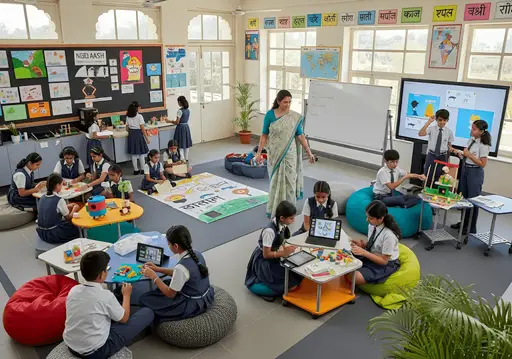
India’s classrooms are undergoing a quiet but profound transformation. For decades, teaching and assessment in schools followed a largely uniform approach: the same syllabus, the same pace and the same examinations for every learner. While this model worked for some, it left many students behind—those who needed more time, different explanations, or deeper challenges.
Adaptive learning is changing this narrative. Powered by artificial intelligence (AI), data analytics and modern educational psychology, adaptive learning systems are enabling classrooms in India to move from “one-size-fits-all” teaching to personalised, learner-centric education. This shift has significant implications for students, teachers, parents and policymakers alike.
This article explores how adaptive learning is reshaping Indian classrooms, why it matters now more than ever and what the future holds for education in the country.
1. The Challenge with Traditional Classroom Models
India’s education system serves one of the largest and most diverse student populations in the world. A single classroom may include learners who differ widely in:
Academic readiness
Language proficiency
Learning speed
Socio-economic background
Access to learning support at home
Despite this diversity, traditional classrooms often progress at a fixed pace. Teachers are under pressure to complete the syllabus, leaving little room to address individual gaps. As a result:
Advanced learners may feel bored and disengaged
Struggling learners may fall behind and lose confidence
Assessments measure memory more than understanding
Teachers rely on marks rather than diagnostic insights
Adaptive learning addresses these structural limitations by shifting the focus from coverage to comprehension.
2. What Is Adaptive Learning?
Adaptive learning refers to the use of technology to adjust learning content, difficulty, pace and assessment in real time based on a learner’s performance and behaviour. Instead of forcing every student through the same pathway, adaptive systems personalise the learning journey for each individual.
At the core of adaptive learning are three key capabilities:
Continuous Assessment – Every interaction (answers, time taken, confidence levels) becomes data.
Intelligent Decision-Making – AI models analyse this data to estimate a learner’s current level of understanding.
Dynamic Content Delivery – Lessons, questions and resources are adjusted to suit the learner’s needs.
In simple terms, adaptive learning systems behave like a highly attentive tutor—observing, understanding and responding to each student in a tailored way.
3. Why Adaptive Learning Is Especially Relevant for India
India is uniquely positioned to benefit from adaptive learning for several reasons.
a. Large Class Sizes
Many Indian classrooms have high student-to-teacher ratios. Adaptive platforms act as a digital teaching assistant, helping teachers monitor individual progress even in large classes.
b. Learning Gaps Post-Pandemic
The COVID-19 pandemic exposed and widened learning gaps across regions. Adaptive diagnostics can quickly identify where students are lagging and recommend targeted interventions.
c. Multilingual and Diverse Learners
Students often study in a second or third language. Adaptive systems can provide alternative explanations, visuals and pacing that accommodate different learning styles.
d. Exam-Oriented Culture
India’s assessment-heavy system benefits greatly from adaptive testing, which focuses on conceptual mastery rather than rote repetition.
4. How Adaptive Learning Works Inside the Classroom
Adaptive learning does not replace teachers; it enhances their effectiveness. Here is how it typically integrates into classroom practice.
Step 1: Diagnostic Assessment
Students begin with a baseline assessment that identifies their current understanding across topics. This is not a pass-or-fail test but a learning map.
Step 2: Personalised Learning Path
Based on diagnostic results, each student receives a customized sequence of lessons and practice activities. A learner struggling with fractions, for example, may receive foundational revision, while another moves on to advanced problem-solving.
Step 3: Real-Time Adaptation
As students interact with content, the system continuously adapts. Correct answers may lead to higher-level questions; incorrect answers may trigger hints, examples, or remedial content.
Step 4: Insightful Feedback
Teachers receive dashboards showing who is struggling, who is progressing, and why. This allows targeted classroom instruction, group activities, or individual support.
5. The Role of AI and Learning Science
Modern adaptive learning platforms combine artificial intelligence with well-established learning theories.
Knowledge Tracing Models estimate what a student knows and does not know at any point in time.
Item Response Theory (IRT) ensures that questions are appropriately challenging and statistically reliable.
Cognitive Psychology principles guide spacing, reinforcement and feedback timing.
This fusion ensures that adaptation is not random but grounded in science.
6. Benefits for Students
Adaptive learning fundamentally changes the student experience.
a. Learning at the Right Pace
Students no longer feel rushed or held back. Each learner progresses when ready.
b. Improved Confidence
By addressing gaps early, adaptive systems prevent repeated failure and build self-belief.
c. Deeper Understanding
Conceptual mastery replaces memorisation, leading to better long-term retention.
d. Fairer Assessment
Students are assessed on ability, not luck or test anxiety, as adaptive tests adjust difficulty dynamically.
7. Benefits for Teachers
Teachers remain central to the learning process, but their role becomes more strategic and impactful.
Reduced administrative burden in grading and tracking
Clear visibility into individual and class-level learning gaps
Data-driven lesson planning
More time for mentoring and interaction
Rather than reacting after exams, teachers can intervene during the learning process.
8. Benefits for Parents and School Leaders
Adaptive learning also brings transparency and accountability.
Parents can track progress beyond marks
Schools can measure learning outcomes across cohorts
Administrators can make informed decisions on curriculum and interventions
This shifts conversations from “How much did my child score?” to “What has my child mastered?”
9. Alignment with India’s Education Reforms
India’s education reforms emphasise:
Competency-based learning
Continuous assessment
Holistic development
Use of technology for inclusion
Adaptive learning aligns naturally with these goals. It operationalises policy intent by embedding personalisation and continuous feedback into everyday classroom practice.
10. Challenges and Considerations
While promising, adaptive learning must be implemented thoughtfully.
Teacher Training: Educators need support to interpret data and integrate insights into teaching.
Digital Infrastructure: Reliable connectivity and devices remain uneven across regions.
Ethical Use of Data: Student data must be handled securely and transparently.
When addressed responsibly, these challenges become manageable rather than limiting.
11. The Future of Classrooms in India
The classroom of the future will not be defined by rows of desks or fixed textbooks. Instead, it will be characterised by:
Blended learning environments
Personalised learning journeys
Continuous, low-stress assessment
Teachers empowered by data, not replaced by technology
Adaptive learning is not a trend; it is a structural evolution in how education is delivered and measured.
Conclusion
Adaptive learning is transforming classrooms in India by placing the learner at the centre of education. It recognises that every student is unique and deserves a learning experience tailored to their needs.
As schools, educators and policymakers increasingly embrace data-driven, student-centric approaches, adaptive learning will play a pivotal role in shaping equitable, effective and future-ready education systems across the country.
The question is no longer whether adaptive learning will become mainstream in India—but how quickly institutions can adopt it to unlock the full potential of every learner.